At bus accidents, emergency teams must cope with multiple casualties simultaneously. The wedge shape creates the correct lift angle from the first pump stroke, maintaining contact with both the road surface and the vehicle bodywork throughout the entire lift.
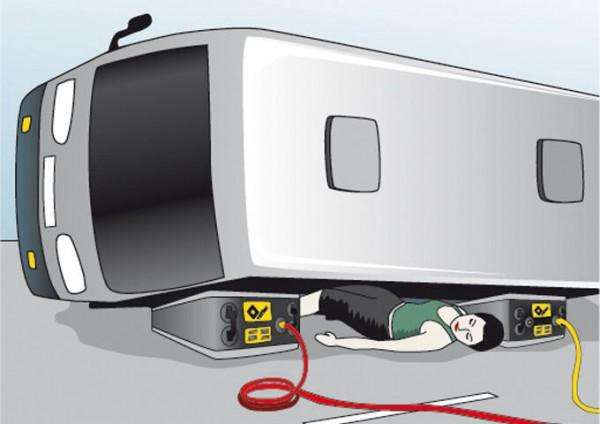
- Working pressure: 1 bar (14.5 psi)
- Lifting capacity: 6 metric tonnes per bag
- Shape: Wedge — optimal lift angle for coach rescue
- Load distribution: Uniform over entire lifting distance
- Contact: Continuous with coachwork and surface throughout lift
- Safe for: Thin-walled bus and coach bodywork
- Standard: EN 13204, CE marked
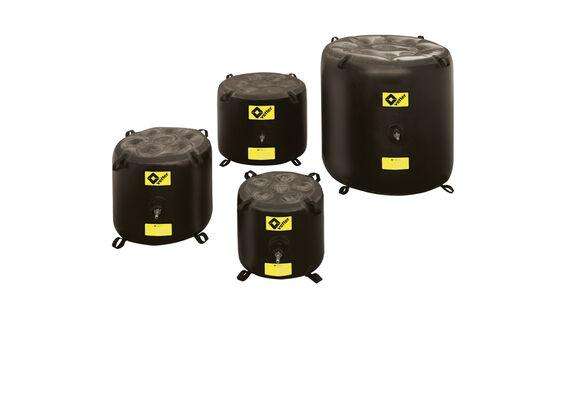
- Contents: 2 wedge bags, 2 × 10 m hoses (red + yellow), deadman controller, pressure regulator, repair kit, valise (80 × 56 × 23 cm)
- Total lift: 12 metric tonnes (2 bags combined)
- Working pressure: 1 bar
- Standard: EN 13204, CE marked
Wedge Set Contents
| Item | Specification | Qty |
|---|---|---|
| Wedge Lifting Bag | 1.0 bar, 6 metric tonnes, quick-action coupling | 2 |
| Inflation hose (yellow) | 1.0 bar, 10 m, quick-action coupling | 1 |
| Inflation hose (red) | 1.0 bar, 10 m, quick-action coupling | 1 |
| Air CU 1-bar deadman with lighting | — | 1 |
| Repair material kit | 0.5 and 1.0 bar | 1 |
| Pressure regulator | 200/300 bar → 14 bar | 1 |
| Valise carry case | 80 × 56 × 23 cm | 1 |
Wedge bags for your rescue fleet?
Vetter Wedge Lifting Bags are supplied as a complete set with hoses, controller and carry case. Contact us for specifications and pricing.
Request a QuoteWedge Bag Applications — Door Forcing and Access
While the Vetter Wedge Bag was originally developed for bus and coach accident scenarios, the same tapered pneumatic design proves equally effective in a broader range of forced-entry and access situations. The wedge shape delivers outward-spreading force progressively as the bag inflates, generating controlled lateral pressure against a door frame, hatch lip or panel edge without the risk of slippage associated with hydraulic spreader tips.
In vehicle door forcing scenarios, the wedge bag is inserted into the existing gap between door and frame — typically as little as 15mm at the latch side — and inflated to generate progressive outward force. Unlike a hydraulic spreader, which must be physically positioned against the external panel, the wedge bag works from within the gap, distributing force across the full insertion depth rather than concentrating it at a point. This makes it particularly suitable for thin-walled vehicle bodywork, fibreglass panels and non-metallic door skins where point-load damage can compromise the structural integrity of the rescue approach.
In aviation rescue operations, wedge bags provide a rapid means of forcing aircraft emergency exit hatches and galley door panels that have jammed or deformed following an impact. The spark-free pneumatic operation is an important safety consideration at aviation incidents where fuel vapour may be present. The complete wedge set operates from a single compressed air cylinder, requiring no hydraulic fluid or electrical power supply at the scene.
Technical Features
- Pointed insertion tip: Enters gaps from approximately 15mm — suitable for closed vehicle doors and latched hatches
- Rated force: Up to 6 tonnes (60 kN) per bag at 1 bar operating pressure
- Operating pressure: 1 bar maximum — extremely low, generates uniform distributed force without risk of panel puncture
- Outer material: Chemical-resistant neoprene — withstands fuel, hydraulic fluid and fire suppression agents
- Controller compatibility: Standard Vetter 1-bar deadman controller — same air supply circuit as standard 1-bar bag range
- No sparks: Fully pneumatic — safe at fuel spill incidents and aviation rescue
- No hydraulic fluid: Eliminates contamination risk on casualties and at scene
- Standard: EN 13204, CE marked
Wedge Bag vs. Hydraulic Spreader
| Factor | Vetter Wedge Bag | Hydraulic Spreader |
|---|---|---|
| Gap required to enter | ~15 mm (tip inserts into existing gap) | 30–50 mm (tool must be positioned externally against panel) |
| Force distribution | Distributed across full bag surface — no point load | Concentrated at spreader tips |
| Risk of slippage | Very low — bag is enclosed within the gap | Higher — tip can slip on smooth painted surfaces |
| Suitability for non-metallic panels | Yes — distributed force does not concentrate stress | Limited — tip point load can puncture thin panels |
| Spark generation | None — fully pneumatic | Possible at point of steel-on-steel contact |
| Hydraulic fluid risk | None | Hydraulic fluid leak risk at high pressure |
| Combined use with lifting bags | Yes — same air supply and controller | Requires separate hydraulic circuit |
Application Scenarios
| Scenario | Wedge Bag Deployment |
|---|---|
| Vehicle door forcing | Insert wedge tip at door latch or hinge gap, inflate to force door outward progressively. Effective on passenger cars, SUVs and commercial vans with thin-wall bodywork. |
| Bus and coach rescue | Original application — wedge shape provides optimal lift angle for thin-walled coachwork while maintaining uniform contact throughout the entire lift from first pump stroke. |
| Aircraft rescue | Force deformed emergency exit hatches and cabin doors. Spark-free operation is critical when fuel is present. Suitable for narrow-body and wide-body aircraft door frames. |
| Container and cargo rescue | Shipping container doors that have buckled or warped can be forced using wedge bags inserted at the lock bar, generating force without damaging container structure. |
| Industrial hatch opening | Access panels, manhole covers and process vessel hatches that have seized or been distorted by heat or impact. Pneumatic approach is safe around process equipment. |
| Marine rescue | Boat cabin doors, bulkheads and hatches that have jammed following a collision or fire. Effective on fibreglass and aluminium marine construction. |
| Train cab access | Deformed train cab doors following a collision can be forced without crane assistance. Deployed alongside LUKAS hydraulic rescue tools in complex rail incidents. |