What is a Decontamination Shower?
A decontamination shower is a portable, rapid-deployment unit used to wash chemical, biological, radiological or nuclear (CBRN) contaminants from casualties or emergency responders at incident sites. Unlike fixed facility showers, portable decontamination shower units can be deployed within seconds directly at the scene — critical when time-to-decon determines casualty outcomes.
Vetter decontamination shower systems use multiple adjustable spray heads to rinse contaminated persons from head to toe. All runoff is channelled into a sealed, self-contained collection basin, preventing secondary contamination of responders or the surrounding area. Units can be operated in standalone configuration or coupled with decontamination shelters to create a fully enclosed undress–shower–redress corridor.
Decontamination Shower & Shelter Range
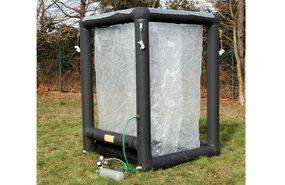
Set up in 30 seconds, ready immediately. Used as emergency decontamination point or in combination with tents. Compact size integrates easily into shelters to extend functional radius. 8 movable shower heads at different heights, replaceable shower curtain and insert tray, raised ergonomic foot support.
Request a Quote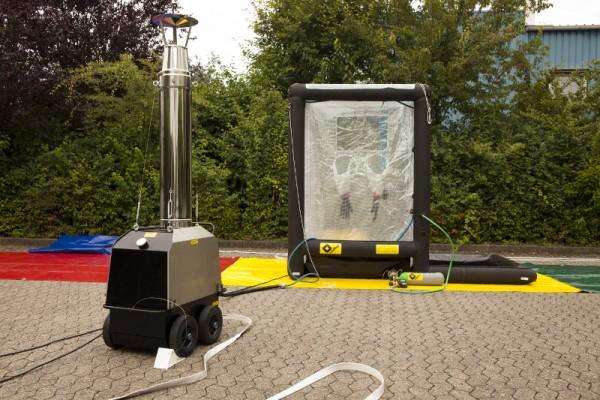
Operational in 40 seconds. Used as emergency decontamination position or in combination with shelters. Features an additional frontal outside basin for cleaning contaminated boots — prevents splashing on the floor. 8 movable shower heads, replaceable curtain and insertion basin.
Request a Quote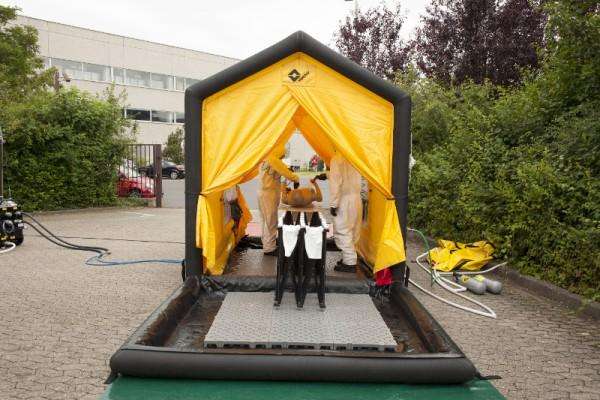
Light and mobile — fits on every emergency vehicle. Fronting basin prevents spread of contaminated liquids. Magnetic fasteners for quick curtain opening/closing. Integrated gloves for cleaning contaminated persons from outside. Eight movable shower nozzles at various heights. Contaminated liquid drains from inlaid basin without submersible pump. Extended by universal shelter to include dressing/undressing areas.
Request a Quote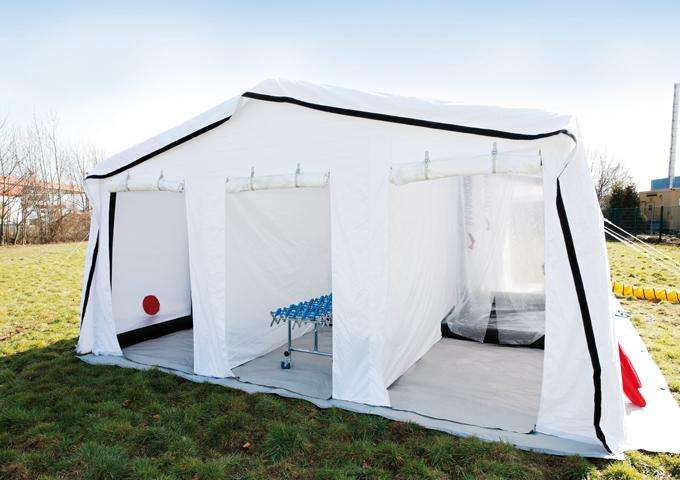
Longitudinal partition divides the shelter into 2 separate decontamination lines — sufficient space for separate showering of men and women. Shower units divide tent into undressing, shower and dressing zones. Each shower unit has an independent water supply for individual temperature and flow control. Colour-coded passages: blue (water), red (heating/power), green (compressed air). Continuous catchment basin prevents liquid migration to other areas. Connect Universal Shelter PZ 17 as additional supply or accommodation tent.
Request a Quote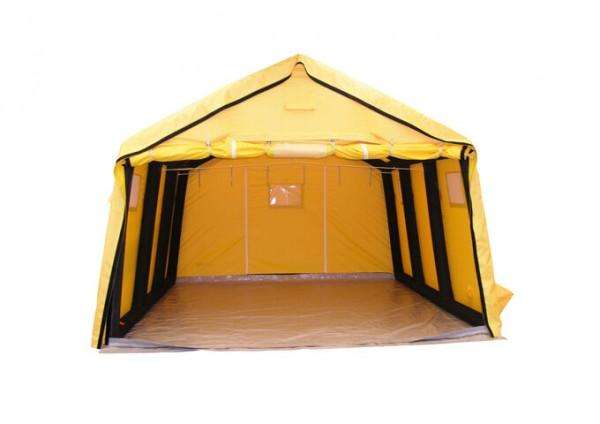
Developed specifically for fire brigades. Self-erecting support frame. Only 2 people needed, ready in under 3 minutes. Low weight, compact folded size. Velcro fasteners for connecting to other shelters or containers. Suitable for: living quarters, triage facilities, decontamination. All Vetter shower units can be added. One-piece system — no loose parts.
Request a Quote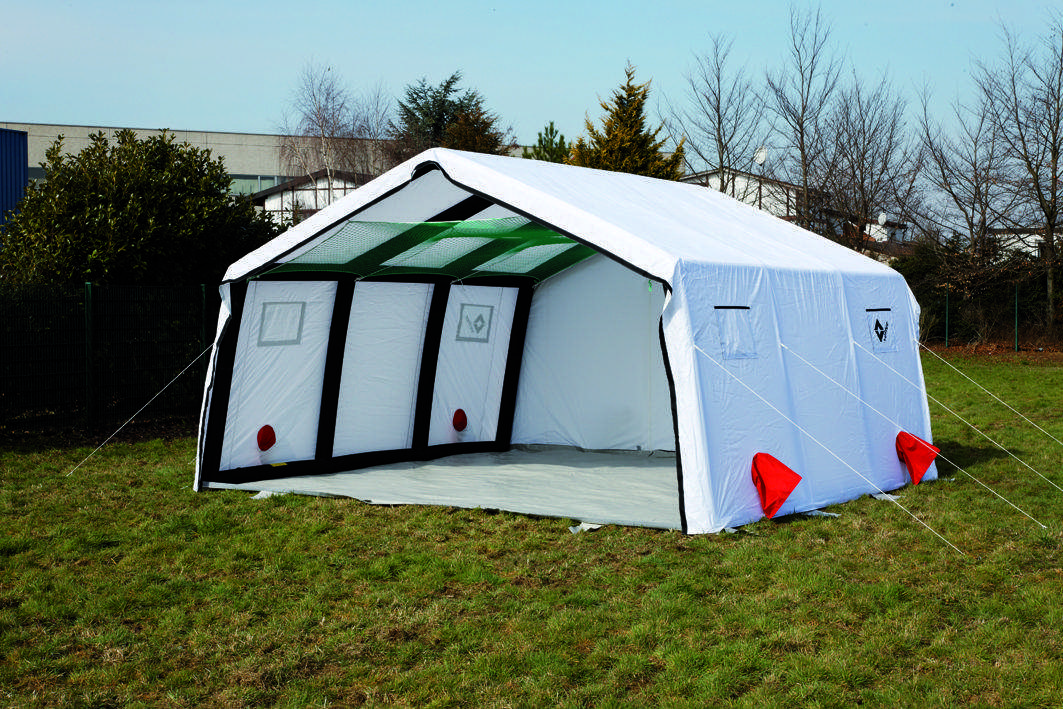
Four sizes: 20 m² to 60 m² usable area. 5.5 m usable width — still 1.5 m passage for medical staff when beds placed crosswise. Modular — connect any number of tents to create a tent city. Premium set: self-erecting frame, throw-over tarpaulin, removable entrance, patented roof securing net, removable barrier-free floor, 4 feedthroughs, windows. Docking shelter available for connecting shelter groups.
Request a Quote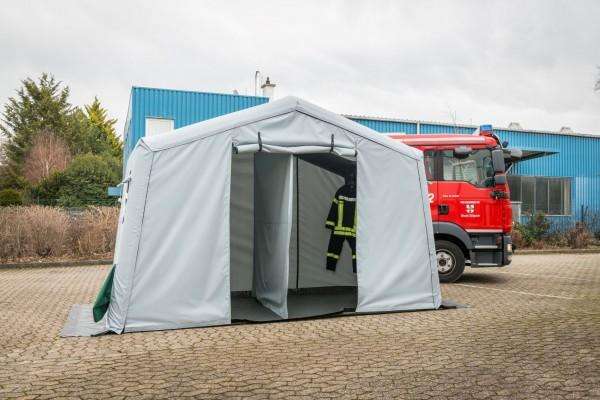
Ready in 1 minute with compressed air or blower fan. Two changing cabins — suitable for squads. Side walls, partition wall and floor tarpaulin pre-attached for self-erection. Hook-and-loop partition wall. Compact — fits behind emergency vehicle or on pavements. Removable floor for easy cleaning. Banners with lettering optionally attachable. Required by DGUV Information 205-035 for contaminated PPE changeover at incident site.
Request a QuoteDecontamination Shower — System Comparison
| Unit | Deploy Time | Shower Heads | Key Feature | Best For |
|---|---|---|---|---|
| Compact Shower | 30 seconds | 8 movable | Fastest deployment; integrates into tent | Emergency decon point |
| Decon Shower | 40 seconds | 8 movable | External boot-cleaning basin | Standard decon operations |
| Dual Decon Shower | 40 seconds | 8 movable | Mobile; integrated assist gloves | Vehicle-mounted rapid decon |
| Decon Shelter PZ 17 2L | < 3 min | Per shower unit | Two-line simultaneous decon | Mass decontamination incidents |
Types of Decontamination Showers
Decontamination showers are available in several configurations, each optimised for a different operational scenario. The right type depends on your expected casualty throughput, available personnel, storage constraints, and whether the unit will be used in standalone or integrated-shelter mode.
The smallest and fastest of the Vetter decontamination showers. Pneumatically self-erecting in 30 seconds, the Compact Shower integrates directly with tent systems and is ideal for pre-hospital decon or integration into larger field hospital setups. Single-person throughput per unit.
The Vetter Decon Shower adds an external boot basin that contains contaminated runoff and prevents tracking to clean zones. Operational in 40 seconds. Used by fire brigades and civil defence units as the primary standalone decontamination shower for HazMat incidents.
The Dual Decon Shower processes two persons simultaneously and includes integrated gloves on the outer wall, allowing responders to assist casualties without entering the contaminated zone. Best suited to incidents with moderate casualty numbers or mixed responder/civilian decon needs.
For large-scale incidents, the Decon Shelter PZ 17 2L creates a full undress–shower–redress corridor running two decontamination lines simultaneously. Multiple shelters can be linked to scale capacity without limit. Used by civil defence and national emergency response agencies for CBRN mass casualty decontamination.
All Vetter decontamination showers are constructed from fire-resistant, UV-stable materials, include adjustable multi-directional spray heads, and channel all runoff water to a sealed integrated collection basin. Systems are compatible with each other and with the Decon Shelter PZ 17 series.
How to Choose a Decontamination Shower System
Selecting the right decontamination shower unit for your organisation depends on four key variables: expected throughput, deployment speed requirements, integration with existing shelter systems, and storage constraints. Below is a practical guide based on the scenarios our customers most commonly face.
| Factor | Compact Shower | Decon Shower | Dual Decon Shower | PZ 17 2L Shelter |
|---|---|---|---|---|
| Deploy time | 30 seconds | 40 seconds | 40 seconds | < 3 minutes |
| Persons per cycle | 1 | 1 | 2 | Continuous (2 lanes) |
| Personnel required | 1 | 1 | 1–2 | 2–4 |
| Runoff containment | Integrated basin | Basin + boot basin | Basin + boot basin | Full corridor basin |
| Shelter integration | Universal Shelter | Universal Shelter | Universal Shelter | Self-contained corridor |
| Best for | Pre-hospital, integration | HazMat first response | Mixed responder/civilian | CBRN mass casualty |
Throughput planning
A single decontamination shower unit processes one person per 3–5 minute cycle (undress, rinse, redress). For an incident with 20 walking casualties requiring decontamination within 30 minutes, plan for at least two standalone decon shower units or one Dual Decon Shower. For mass decontamination events — industrial accidents, stadium evacuation, CBRN terrorism — the PZ 17 2L Shelter running two lanes simultaneously will process significantly higher volumes; additional shelters are linked to scale without limit.
Water supply considerations
Vetter decontamination showers connect to standard fire hose couplings and operate at normal fire service pressures. Hot water capability requires a portable heating unit — ask about the Vetter hot-water heating system when planning extended decon operations in cold climates or where casualty dignity and hypothermia prevention are priorities.
CBRN vs HazMat applications
CBRN decontamination shower requirements differ from standard HazMat decon in that they must also manage radiological contamination surveys (portal monitoring) and biological agent protocols. The PZ 17 2L Shelter supports integration with portal monitors at zone transitions. For pure HazMat chemical incidents — petrochemical spills, chlorine gas, ammonia releases — the standard Decon Shower or Dual Decon Shower is sufficient and significantly faster to deploy.
Decontamination Shower Use Cases
Decontamination shower systems are deployed across a wide range of emergency and industrial scenarios. The following use cases reflect typical operational requirements for the regions we serve: UAE, Egypt, Sub-Saharan Africa, and North Africa.
International airports are required under ICAO emergency planning standards to maintain CBRN decontamination capability. A typical airport setup uses two Decon Shower units stationed at different terminal zones, with a PZ 17 2L Shelter held in reserve for mass casualty events. The Compact Shower integrates into the airport medical centre for isolated casualty decon.
Refineries, LNG terminals, and petrochemical plants are among the highest-risk environments for HazMat chemical exposure. On-site emergency teams typically pre-position a Dual Decon Shower at the site safety station and a PZ 17 2L Shelter at the main assembly point. Rapid decontamination of workers exposed to hydrogen sulphide, ammonia, or hydrocarbons requires a unit that deploys within seconds of an alert.
Civil defence agencies and national disaster response teams running mass decontamination exercises link multiple PZ 17 2L Shelters in series to simulate high-volume corridor throughput. The modular Vetter system allows a single crew to set up a complete decon corridor — undress zone, two-lane shower unit, redress zone, contaminated clothing collection — in under 10 minutes with four personnel.
USAR teams operating in collapsed structures involving asbestos, industrial chemicals, or radiological sources require decontamination capability at the equipment exclusion zone boundary. The Compact Shower is the preferred unit for USAR decon corridors — lightweight, quick to set up, and designed to integrate with tent systems already used in the field hospital zone.
Port security teams responding to suspicious packages or vessel contamination incidents need a decontamination shower system that can be rapidly transported to the berth or quayside. The Decon Shower on a dedicated trailer — available as a packaged solution through Fire and Rescue Tech — provides a self-contained unit ready for deployment within 60 seconds of arrival at the incident scene.
Military CBRN units and national civil defence agencies operating across the Middle East and Africa deploy Vetter decontamination shower systems as part of their standard CBRN response capability. The PZ 17 2L Shelter satisfies NATO STANAG requirements for decontamination shower station design, and the entire system packs into a manageable load for vehicle transport on standard 4×4 or larger military platforms.
Frequently Asked Questions — Decontamination Showers
What is a decontamination shower and how does it work?
A decontamination shower is a portable emergency unit used to remove chemical, biological, radiological or nuclear (CBRN) contaminants from casualties or responders. It uses multiple adjustable shower heads to rinse contaminated persons with water, channelling runoff into a sealed collection basin to prevent secondary contamination. Vetter decontamination showers are pneumatically self-erecting — they deploy in 30 to 40 seconds and require just one or two personnel.
How quickly does a portable decontamination shower deploy?
The Vetter Compact Shower deploys in 30 seconds. The standard Decon Shower and Dual Decon Shower are operational within 40 seconds. The full Decon Shelter PZ 17 2L is ready in under 3 minutes with 2 personnel. These deployment times are critical at CBRN and HazMat incidents where immediate decontamination limits casualty contamination spread.
Can decontamination showers be combined with shelters?
Yes. All Vetter shower units couple directly with the Universal Shelter and the Decon Shelter PZ 17 2L to create fully enclosed decontamination corridors with separate undress, shower and dress zones. The PZ 17 2L features a two-line layout — men and women can be decontaminated simultaneously in parallel lanes, each with independent water temperature and flow control.
What capacity does a decontamination shower system support?
A single shower unit handles one or two persons at a time. The Decon Shelter PZ 17 2L runs two parallel decon lines simultaneously. For large-scale mass decontamination, multiple shelters are linked to create a tent city with unlimited capacity. This modular approach scales from a single chemical casualty to mass decontamination of hundreds of affected persons.
Are Vetter decontamination showers available in the Egypt and Africa?
Yes. Fire and Rescue Tech is the authorised distributor of Vetter decontamination shower systems for fire brigades, civil defence and industrial emergency services across the UAE, Egypt and Africa. We supply complete decon configurations — showers, shelters, PPE changing tents and medical tent systems — with full technical support and after-sales service. Contact us for pricing and lead times.
What is a CBRN decontamination shower and how does it differ from a standard decon shower?
A CBRN decontamination shower is designed to handle chemical, biological, radiological and nuclear contaminants — a broader threat range than a standard HazMat decon shower, which is primarily designed for chemical incidents. CBRN decontamination showers must support integration with radiological portal monitors at zone transitions, have materials that resist biological agent degradation, and provide an undress–shower–redress corridor with clearly separated clean and dirty zones to prevent cross-contamination. The Vetter PZ 17 2L Shelter meets all of these requirements and is used by CBRN response units across the Middle East and Africa.
How much does a decontamination shower unit cost?
Decontamination shower unit pricing varies by model and configuration. Entry-level portable units such as the Vetter Compact Shower represent the most cost-effective entry point for organisations requiring fast single-person decon capability. The Dual Decon Shower and PZ 17 2L Shelter system are priced at a higher tier reflecting their greater throughput and integration capability. Fire and Rescue Tech supplies all Vetter decontamination shower systems to fire brigades, civil defence agencies, and industrial emergency response teams across the UAE, Egypt and Africa. Contact us for a quotation based on your specific requirements, including system configuration, accessories and after-sales support.
What training is required to operate a decontamination shower?
Vetter decontamination showers are designed for rapid deployment by fire brigade and civil defence personnel with basic HazMat training. The pneumatic self-erecting mechanism means no tools are required and the unit can be set up by a single operator. We recommend that all operators attend a practical familiarisation session covering deployment, water connection, zone setup, and recovery/decontamination of the unit itself after use. Fire and Rescue Tech can arrange product training as part of the supply and commissioning process.
Need decontamination shower capability for your unit?
We supply Vetter decontamination shower systems and shelters for fire brigades, civil defence, CBRN response teams and industrial emergency services across Africa and the MENA region. Contact us for system configuration, capacity planning and pricing.
Request a Quote